
If you are thinking about government jobs in India, you have probably heard about UPSC many times. However, most beginners still do not clearly understand what it actually means or how it works.
So before jumping into preparation, let’s answer the most basic question in a simple way
What is UPSC
In this guide, you will understand UPSC clearly, giving you the clarity and direction most beginners lack.
What is UPSC?
UPSC stands for Union Public Service Commission. It is a central government body responsible for conducting exams to recruit candidates for top government positions in India.
In simple terms, UPSC is the organization that selects officers like:
- IAS Indian Administrative Service
- IPS Indian Police Service
- IFS Indian Foreign Service
So when someone says they are preparing for UPSC, they are usually preparing for the Civil Services Examination conducted by UPSC.
Do You Know?
According to the UPSC Annual Report, More than 25 Lakhs applications were received, out of which 35,718 candidates were interviewed and only 7,999 were selected, highlighting the scale and competition of UPSC exams.
Source: Union Public Service Commission Annual Reports
What Does UPSC Do
UPSC performs multiple important functions beyond just one exam.
Conducts Civil Services Examination
This is the most popular exam that selects IAS IPS and IFS officers.
Recruits for Other Services
UPSC also conducts exams like:
- NDA National Defence Academy
- CDS Combined Defence Services
- Engineering Services
Advises the Government
UPSC also gives advice on recruitment rules promotions and disciplinary matters.
Why UPSC is Important
UPSC is one of the most respected exams in India because it selects people who run the administration of the country.
Officers selected through UPSC:
- Implement government policies
- Maintain law and order
- Work in administration and governance
This is why UPSC is not just an exam but a responsibility.
UPSC Exam Structure
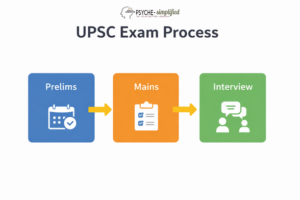
To fully understand what is UPSC, you must know how the exam works. The Civil Services Examination is conducted in three stages, and each stage tests a different skill set of the candidate.
Preliminary Examination
This is the first stage of the exam and acts as a screening test. It consists of objective type questions from General Studies and CSAT. The marks of this stage are not counted in the final ranking, but clearing it is necessary to move to the next stage.
Mains Examination
This is the most important stage of the exam. It is a descriptive written exam that includes essays, general studies papers, and an optional subject. It tests your depth of knowledge, answer writing ability, and analytical thinking.
Interview
This is the final stage, also known as the personality test. It does not test knowledge alone but focuses on your confidence, clarity of thought, decision making, and overall personality. Your final selection depends on the combined score of Mains and Interview.
Eligibility for UPSC
Before starting preparation, it is important to understand the eligibility criteria for UPSC. These basic requirements help you know whether you can apply for the exam.
Age Limit
To apply for UPSC, candidates must be at least 21 years old. The upper age limit is 32 years for the general category. Relaxation in age is provided for reserved categories such as OBC, SC, and ST as per government rules.
Educational Qualification
Candidates must have a graduation degree from a recognized university. Students from any stream can apply, and even final year students are eligible, provided they complete their degree before the Mains examination.
Number of Attempts
UPSC allows a limited number of attempts for each candidate. General category candidates can attempt the exam 6 times, while OBC candidates get 9 attempts. For SC and ST candidates, there is no fixed limit on attempts until they reach the upper age limit.
How to Start UPSC Preparation
If you are a beginner, start with clarity rather than rushing into multiple resources. Focus on building a strong base and follow a simple, structured approach.
Understand the Syllabus
Always begin with the UPSC syllabus. It will guide you on what to study and what to ignore.
Start with NCERT Books
Build your basics first through NCERT books before moving to advanced sources.
Read Newspaper Daily
Develop the habit of reading a newspaper to improve your understanding of current affairs.
Choose Optional Subject
Select an optional subject based on your interest and comfort, as it plays a key role in Mains.
Practice Answer Writing
Start answer writing early, even in a simple way, to improve your expression and clarity.
Common Mistakes Beginners Make
Many aspirants struggle because they make avoidable mistakes:
- Starting preparation without understanding the exam
- Using too many resources
- Ignoring revision
- Not practicing answer writing
- Being inconsistent
Avoiding these common mistakes early can save you months of confusion and help you stay on the right path throughout your UPSC preparation.
Tips for UPSC Beginners
- Focus on consistency rather than long study hours
- Build strong concepts before moving to advanced topics
- Revise regularly
- Make short notes for quick revision
- Stay patient and trust the process
If you follow these simple tips consistently, your UPSC preparation will become more structured, manageable, and effective over time.
FAQs
1.What is UPSC in simple words
UPSC is a government body that conducts exams to recruit officers like IAS IPS and IFS.
2.What is UPSC full form and meaning
UPSC stands for Union Public Service Commission which selects candidates for central government services.
3.Is UPSC very difficult
Yes it is considered one of the toughest exams due to its vast syllabus and competition.
4.Can beginners crack UPSC
Yes, with proper strategy and consistency, beginners can clear UPSC.
Conclusion
Now you clearly understand what UPSC is and how it works. Focus on building a strong foundation and staying consistent in your preparation.
If you are considering Psychology Optional, you can explore our structured batch to build clarity and improve answer writing. You can explore our Psychology Foundation Course For Psychology Optional.


Follow Us