
Psychology Optional Syllabus Overview and Trend Analysis
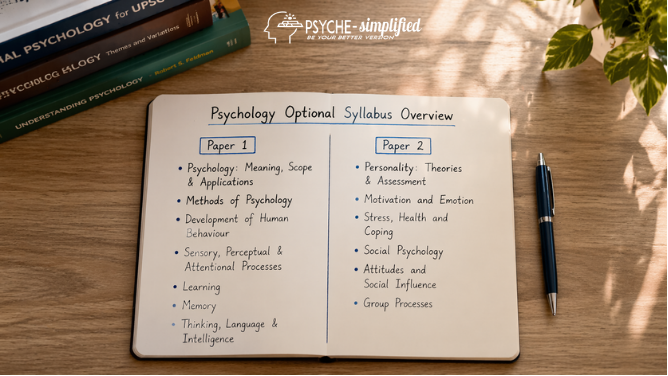
Psychology optional syllabus overview is the first step in building a clear and structured preparation for UPSC. At the same time, understanding the psychology optional trend helps you know how the subject is evolving and what UPSC expects.
Many aspirants either focus only on syllabus or only on trend, but a balanced understanding of both gives you a strong advantage.
In this guide, you will:
- Understand the complete syllabus summary psychology
- Analyze psychology optional trend over the years
- Identify important topics and scoring areas
- Build a preparation strategy based on real exam patterns
Did You Know?
The Psychology Optional syllabus is designed in a way that concepts from Paper 1 are directly applied in Paper 2, which is why understanding the syllabus structure is crucial for scoring well.
Psychology Optional Syllabus Overview
A clear psychology optional syllabus overview helps you understand the scope of the subject and prepare in a structured and focused way.
Knowing what to study in each topic ensures better clarity, better notes, and better answer writing.
Paper 1: Foundations of Psychology
| Topic | Sub-Topics |
|---|---|
| Introduction |
|
| Methods of Psychology |
|
| Research Methods |
|
| Development of Human Behaviour |
|
| Sensation, Attention and Perception |
|
| Learning |
|
| Memory |
|
| Thinking and Problem Solving |
|
| Motivation and Emotion |
|
| Intelligence and Aptitude |
|
| Personality |
|
| Attitudes, Values and Interests |
|
| Language and Communication |
|
| Issues and Perspectives in Modern Contemporary Psychology |
|
Paper 2: Applied Psychology
| Topic | Sub-Topics |
|---|---|
| Psychological Measurement of Individual Differences |
|
| Psychological Well Being and Mental Disorders |
|
| Therapeutic Approaches |
|
| Work Psychology and Organisational Behaviour |
|
| Application of Psychology to Educational Field |
|
| Community Psychology |
|
| Rehabilitation Psychology |
|
| Application of Psychology to Disadvantaged Groups |
|
| Psychological Problems of Social Integration |
|
| Application of Psychology in Information Technology and Mass Media |
|
| Psychology and Economic Development |
|
| Application of Psychology to Environment and Related Fields |
|
| Application of Psychology in Other Fields |
|
| Psychology of Gender |
|
This syllabus gives you a clear structure for both Paper 1 and Paper 2, helping you cover each topic with clarity and build strong answers.
Psychology Optional Trend Analysis
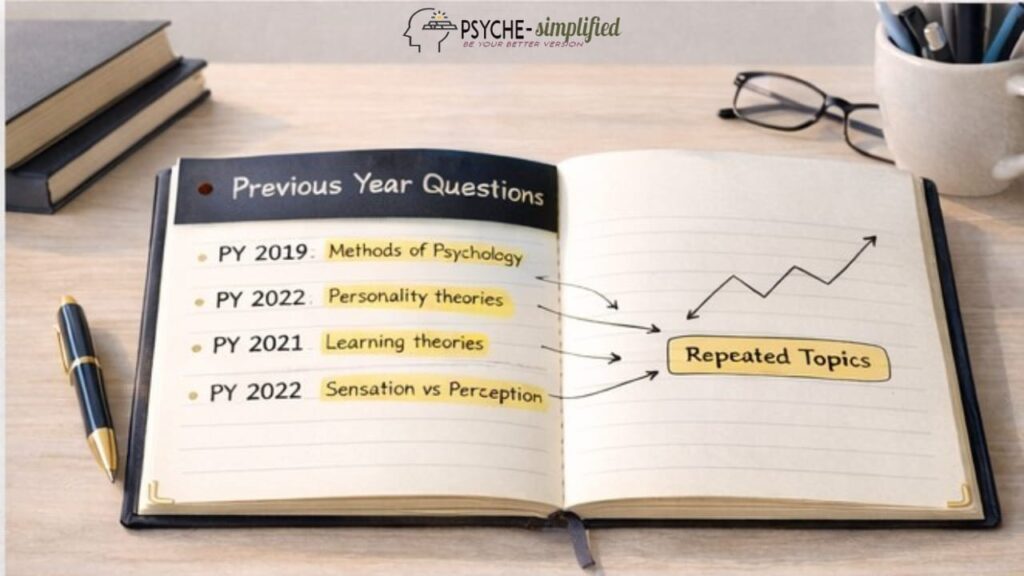
Understanding the psychology optional trend is essential if you want to prepare strategically rather than randomly. While the syllabus tells you what to study, trend analysis tells you how UPSC is asking questions and what actually scores.
Over the years, psychology optional has remained stable in structure, but the nature of questions and answer expectations has evolved significantly.
A close analysis of previous year questions shows three clear patterns:
- Shift from direct theoretical questions to application based questions
- Repeated focus on core topics across multiple years
- Increasing emphasis on clarity, structure, and examples in answers
This means preparation today is not just about covering the syllabus, but about understanding how to use those concepts in answers.
If you want to build this approach in a structured way, you can explore our Psychology Optional Courses.
Topic Wise Trend Analysis
| Weightage Level | Topics | Trend Insight |
|---|---|---|
| High Weightage | Learning, Memory, Intelligence, Personality, Research Methods, Social Psychology | Frequently repeated topics with direct and application based questions, form the core scoring areas |
| Medium Weightage | Motivation and Emotion, Developmental Psychology, Perception and Attention, Industrial Psychology, Health Psychology | Asked regularly with variation in question framing, require conceptual clarity and examples |
| Low Weightage | Indian Psychology, Rehabilitation Psychology, Psychological Measurement | Less frequent but unpredictable, questions are often application based and require selective preparation |
Focusing on high weightage areas while not ignoring medium and low weightage topics helps you prepare in a balanced and exam oriented way.
Nature of Questions Asked by UPSC
Recent psychology optional trend shows that UPSC is not asking direct theory anymore.
- Questions are concept based but demand application
- Static topics are linked with real life situations
- Answers are expected to be multi dimensional
For example, instead of asking a direct theory, UPSC often asks its application in social or real life contexts.
Shift Towards Application Based Preparation
One of the biggest changes in recent years is the shift towards application oriented answers.
- Concepts must be linked with examples
- Paper 1 theories must be used in Paper 2
- Answers should show understanding, not memorization
This is where most aspirants lose marks despite knowing the content.
Common Mistakes in Trend Based Preparation
- Studying without PYQ analysis
- Memorizing without understanding application
- Ignoring answer writing
- Treating Paper 1 and Paper 2 separately
Avoiding these mistakes improves both clarity and scores.
Understanding the psychology optional trend helps you prepare smarter, focus on what matters, and write answers the way UPSC expects.
How to Use Syllabus and Trend Together
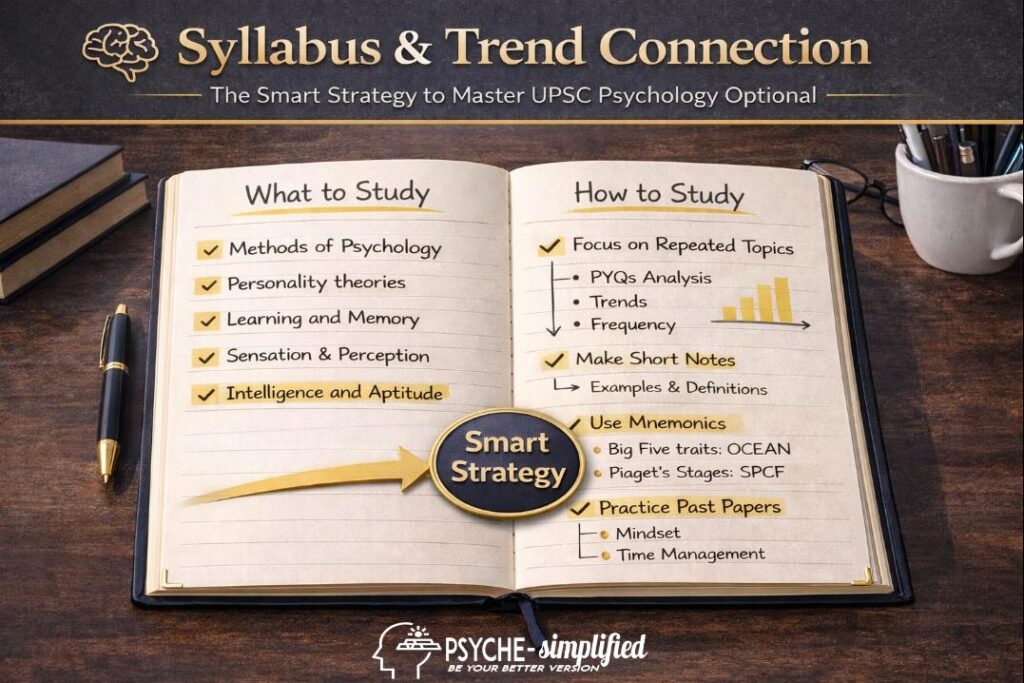
A strong preparation strategy combines both:
- Use syllabus to know what to study
- Use trend to know how to study
- Focus on repeated and important areas
- Align answers with UPSC expectations
Why Psychology Optional Remains Popular
The popularity psychology optional continues because:
- It is scoring with the right strategy
- It is beginner friendly
- It overlaps with GS and Essay
- It requires clarity, not rote learning
At Psyche Simplified, our students have achieved strong scores by applying this exact approach consistently throughout their preparation.
Conclusion
A clear psychology optional syllabus overview combined with a proper understanding of the psychology optional trend gives you a strong foundation for preparation.
It helps you focus on the right topics, avoid unnecessary sources, and align your answers with what UPSC actually expects.
The key is not just to cover the syllabus, but to understand patterns, prioritize important areas, and practice answer writing consistently.
Prepare with a clear system through our Psychology Optional Courses.
Start your Psychology Optional preparation with a clear and structured approach.
Our new Foundation Batch starting on 11 May 2026 is designed to help you master concepts, improve answer writing, and stay consistent in your preparation.
Also Read
Explore related guides to strengthen your Psychology Optional preparation.
Frequently Asked Questions (FAQs)
It is a complete outline of all topics in Paper 1 and Paper 2 that helps you understand what to study for UPSC Psychology Optional.
It shows how UPSC frames questions, which topics are repeated, and what type of answers score better.
Yes, psychology optional is scoring if prepared with clarity, structured notes, and consistent answer writing practice.
Use the syllabus to define what to study and trend analysis to understand how to study and answer effectively.
It is beginner friendly, has a defined syllabus, overlaps with GS, and rewards conceptual clarity over rote learning.

Follow Us